How to Outsource 3D Rendering for Furniture
A brand can outsource 3D furniture rendering in four ways: per image, per SKU package, per project, or as a monthly plan. Per-SKU packages suit simple marketplace images, a project quote suits one large launch, and a monthly plan suits brands that release collections through the year. The right choice depends on your rhythm of work more than on the price of one image.
This guide compares the four models and works through three real-sized catalogs. It is about how to pay. For how to judge the studio itself, see how to choose a 3D rendering partner.
How can a furniture brand pay for outsourced 3D rendering?
There are four common models, and each one puts the risk in a different place. With a price per image the studio carries the effort and you carry the count. With a monthly plan you carry the hours and the studio carries the planning.
| Model and best use | Price |
|---|---|
| Per image, for hero shots | €200–2,000 |
| Per SKU, for marketplaces | $198 |
| Per project, for one launch | Quoted |
| Monthly, for steady work | $500–2,399+ |
The per-image range is Design Elite’s estimate for one visual from a freelancer or specialist studio. The $198 package is CGIFurniture’s, and covers up to 100 images. The monthly range, per month, runs from our 25-hour plan at $500, through Design Elite at €899.90, to Rendify from $2,399. All were read from each company’s own site in November 2026. They buy different things, so the table shows the shape of each offer. It cannot rank them.
When does paying per image make sense?
Paying per image makes sense when you need fewer than a handful of visuals and the 3D model already exists. A single hero shot for a campaign or a lookbook is a clean, one-off purchase.
It gets expensive when the first image also has to pay for the model. Most of the work in a furniture render sits in the modeling, which is why brands often outsource 3D modeling first: on our own plan, a new product with three angles on white takes 6–10 team hours, while another fabric on the finished model takes 30–60 minutes per angle. If a price per image hides that split, you pay for the same model more than once, or you pay a flat price that never drops as the model gets reused.
Ask one question before you accept a per-image price: what does the tenth image of this product cost compared with the first?
When does a per-SKU package make sense?
A per-SKU package makes sense when the output is standard and the volume is high. CGIFurniture’s published package is $198 for up to 100 marketplace images: a 10-image set per SKU, multiplied across colors and modifications, plus a reusable 3D model.
For a sofa sold in ten fabrics on Amazon and Wayfair, that is a hard offer to beat. The views are fixed, the brief is short and the price is known on day one. We would point a brand with this exact need to a package before a monthly plan.
The limit is the format. A package covers a defined set of images, so anything outside the set is a separate conversation: a styled room, a collection scene, a 360° spin or a GLB file for Amazon 3D.
When does a project quote make sense?
A project quote makes sense when one launch has a clear scope and a date. The studio prices the whole list together, and as a rule the more images you order in one project, the lower the cost per image.
Our furniture rendering catalog for Dragonfly Furniture is the typical case: 30 SKUs in 6–8 weeks, with every color variation coming from one set of 3D models and $8,000+ saved on logistics against a traditional shoot. A list that long is worth quoting once. A 50-SKU catalog takes about two months, and nobody needs to renegotiate during that time.
The weak point is everything that arrives after the quote. A new fabric in spring, three more angles for a retailer, a late product in the range: each one needs a new estimate and a place in the studio’s queue. With one launch a year, that hardly matters. With four, the quoting becomes a job of its own.
When does a monthly plan make sense?
A monthly plan makes sense when work arrives steadily and in small pieces. You reserve a block of capacity, and new products, fabrics and room scenes go into it without a new quote each time.
Monthly plans differ more than their prices suggest, so compare what one month actually buys. Rendify’s plan from $2,399 a month is priced per active scene. Design Elite’s from €899.90 a month covers three requests. Ours is counted in hours: 25 hours for $500, 50 for $1,000 and 100 for $2,000, with the hours for every task agreed before work starts and unused hours moving to the next month once.
The risk is paying through a quiet month. Check whether the plan can be paused and whether anything rolls over. A plan with no pause and no rollover turns a slow season into a loss.
Which model fits your catalog? Three worked examples
The model follows from how many products you launch and how often. These three examples use the hours from our task list; swap in your own studio’s figures and the logic holds.
One launch a year, 30 products. Each new product on white with a room shot takes 17–25 hours, so the launch is 510–750 team hours in one block, then nothing. Quote it as a project. A monthly plan would need five to eight months at 100 hours, far longer than a launch can wait.
A collection every four months, four products each. A product with a room shot, plus six more fabric views, takes 20–31 hours, so one collection is 80–124 hours. Spread over the four months before each launch, that is 20–31 hours a month. This is the case monthly plans are built for: a 25-hour plan costs about $6,000 a year, and fabrics and late changes fit without a new quote each time. In a heavier season, add hours or move up a plan.
Sixty products on marketplaces, no room scenes. The need is the same set of views for every SKU in every color. Take a per-SKU package. If the models already exist, marketplace images on our plan take 30–60 minutes per angle, which is a poor match for a fixed set at volume.
What should you settle before outsourcing 3D rendering?
Settle who owns the 3D models before the first image is delivered. The model is the asset that keeps paying: it produces every later color variation, the 360° views and the AR files. If the studio keeps it, your next collection update starts with a negotiation.
Five more points belong in writing, whichever model you choose:
- Revisions. How many rounds are included, and what one extra round costs. On our projects three rounds are included; on our monthly plan revisions count as hours.
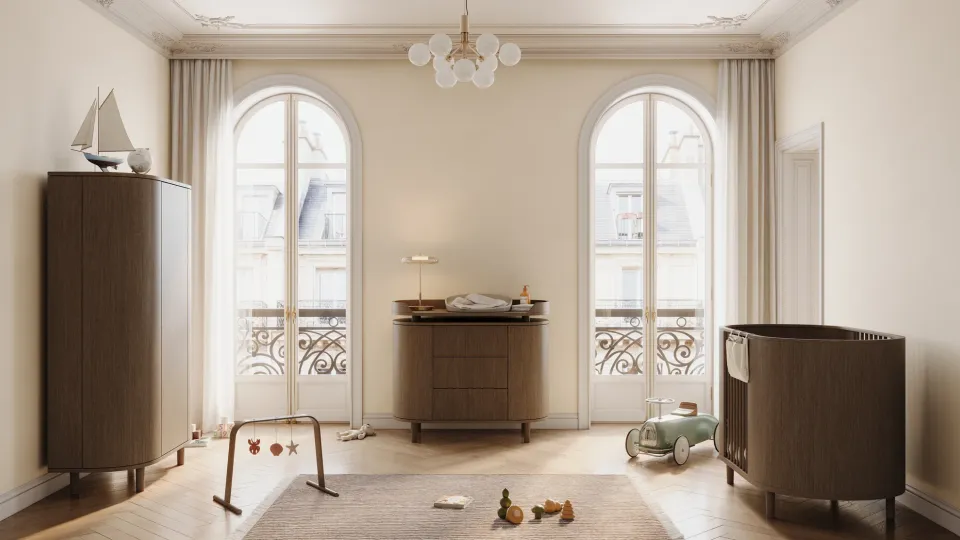
- Input. What the studio needs to start. CAD files are not required: we modeled the Kai nursery range for KAS Kopenhagen from the photos and technical drawings the brand sent.
- Estimate overruns. What happens when a task takes longer than quoted. On our plan the first 15% over the estimate is on us, and past that we stop and ask.
- Confidentiality. An NDA signed before unreleased products leave your hands.
- Timing. Dates in writing. Huggleberry Hill’s 15 wallpaper rooms took four weeks with three rounds of revisions, and a good studio can give you a comparison like that from its own work.
When should you not outsource 3D rendering?
Hire in-house when you have work for one person, all year, and you need them close: same-day changes, many tasks at once, products that cannot leave the building. At about 160 hours of 3D work every month, a salaried artist can cost less than paying per image or per project, though rarely less than a monthly plan. An in-house 3D artist costs about $9,500 a month in the US once employer costs and software are added, against from $3,200 for 160 team hours at the rate of our largest plan, shared by the artist, a project manager and an art director. Plans stop at 100 hours, so a month that size is something we would talk through first.
Below that level you pay a full salary for part-time work, so outsourcing usually wins. And if your products are few and you can ship them to a studio, compare 3D rendering with photography first. For one small product in one finish, a photo can be the simpler answer.
Frequently asked questions
How much does it cost to outsource 3D rendering?
Published prices run from $198 for a package of up to 100 marketplace images to €200–2,000 for a single visual through a freelancer or studio, by Design Elite’s estimate. Monthly plans start at about $500 for 25 hours and reach $2,399 and more. The cost depends mostly on whether a 3D model has to be built first.
Is outsourcing 3D rendering cheaper than hiring?
Yes, below about 160 hours of 3D work a month, because a salaried artist is paid whether there is work or not. Above that level, all year round, a salary can beat prices per image or per project, but it rarely beats a monthly plan.
Who owns the 3D models when you outsource?
It depends on the contract, so settle it in writing before work starts. At Render Friends the client owns the models, the renders and every file we make for them.
How long does outsourced furniture rendering take?
Ten to twenty products on white take 1–2 weeks, and a catalog of about 50 SKUs takes around two months with modeling and revisions. Our paid pilot of one product with three angles on white and a room scene takes seven working days once the brief is confirmed.
Can you switch between models?
Yes. A common path is a project for the first collection, then a monthly plan for fabrics and new products once the models exist. Check that you own the models first, or the switch means building them again.
What is the difference between a 3D rendering retainer and a subscription?
Very little in practice: both reserve capacity for a monthly fee. A retainer may run for a fixed term, while a subscription may be cancelled or paused. Read the terms, because studios use the two words loosely.
Not sure which model fits your next collection?
Send us your website and your next collection. Our free improvement plan lists what to do first, with the hours for each item, so you can compare it with any quote you have. There is no sales call: you get a document.
Sources
- CGIFurniture, 3D rendering services: $198 package, read November 4, 2026.
- Design Elite, 3D services: plans and the €200–2,000 estimate, read November 4, 2026.
- Rendify, pricing: from $2,399 a month for one active scene, read November 3, 2026.
- Hours, plans and project figures: Render Friends, monthly plan and project records.