360° Product Photography vs Rendered 360° Views for Furniture
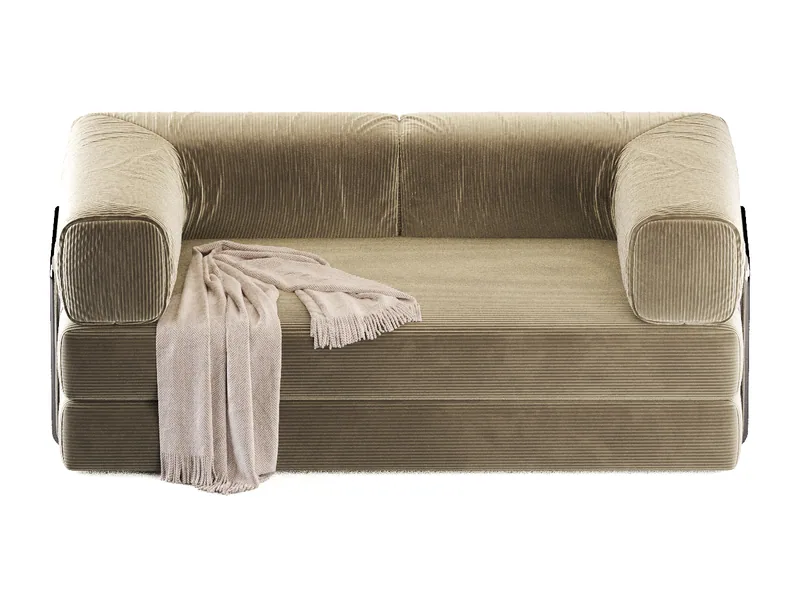
Drag in any direction
ColourwayOat
Drag sideways to turn the demo sofa, up or down to tilt it. Every angle is a finished render.How it is built
For a furniture collection sold in several fabrics, rendered 360° views usually cost less than 360° product photography, and they stay consistent from one season to the next. For one small product in one finish that already exists, a 360° shoot is still the simpler buy. The rest of this article is the arithmetic behind that answer, using published US rates and the measured numbers of the demo sofa on our 360° product views page.
What 360° product photography involves
The product stands on a motorized turntable. The camera stays still and takes a frame every few degrees while the table turns, and software stitches the frames into a spin the shopper can drag. For a view from more than one height, the whole turn is shot again with the camera raised.
Two things follow from that setup. Every colorway is a separate physical sample that goes on the turntable and is shot from scratch. And the turntable and the studio have to be big enough for the product, which for a sofa means a large studio rather than a tabletop rig.
Published US rates for the work:
| What | Rate | Source |
|---|---|---|
| 360° product photography | $150–500 per item | Lars Miller Media, 2026 |
| 360° photography, hourly | about $200 | Home Studio List, 2025 |
| 360° photography, full day | about $1,500–1,600 | Home Studio List, 2025 |
| White background, complex item | $75–150 per shot | Lars Miller Media, 2026 |
Neither source quotes furniture separately. A sofa needs more space and handling than the average product; how that moves the price, they do not say, so the figures below use their rates as published.
What a rendered 360° view is
A rendered 360° view is built from a 3D model instead of a camera. Every angle the customer can turn to is rendered in advance, at the same quality as the catalog’s hero images, and the page swaps between them as the customer drags.
The sofa at the top of this article is that demo: drag it sideways to turn it, up or down to tilt it. It is 205 renders: 41 turns across the front at five camera heights, covering 80° of turn and 20° of height. Between two renders the viewer uses each render’s depth to turn it the last degree or two, so the motion is continuous rather than stepping from frame to frame. The front arc is a choice made for speed, not a limit: a full 360° turn at the same 2° spacing is 180 renders instead of 41, so it shows the back of the piece but takes longer to load.
A rendered 360° view is not the same as a 3D model viewer, where the customer’s phone draws a GLB file live. A model viewer turns all the way round and can place the piece in the customer’s room, but the phone draws simpler light and materials. A rendered view keeps the finished render. The comparison table on the service page sets the two side by side.
The colorway arithmetic
Colorways are where photography and rendering split. Take one collection: 30 sofas, each sold in four fabrics.
With photography, every fabric is a physical sample on the turntable. That is 120 spins. At the published $150–500 per item, the spins alone come to $18,000–60,000, before the 120 samples have been made, shipped to the studio and shipped back.
With rendering, the cost sits mostly in the 30 models. A fabric is a material change on a model that already exists, rendered from the same camera positions. On the demo sofa, one more colorway takes about a quarter of an hour of rendering for the 41 views of a turn. For the 205 views of turn and tilt, it takes about 80 minutes. The fourth fabric costs render time, not a fourth shoot.
The gap widens with every fabric added to the range, and it is widest for a collection that launches before the samples exist. A shoot needs the sofa. A render needs the 3D model, which can be built from CAD files or drawings while the factory is still tooling up. How one model turns into every colorway is covered step by step in how one 3D model becomes unlimited color variations.
Consistency across a catalog
A 360° spin is a comparison tool. The shopper turns one sofa, then the next, and expects them to behave the same way. That only works if every spin has the same camera height, the same distance, the same light and the same crop.
A shoot spread over several days or several seasons drifts on all four. A rendered catalog does not: the camera positions are numbers in a file, so the piece launched next year turns exactly like the one launched today. On our demo the customer can stop at an angle, switch from Oat to Sage, and see the new fabric from the identical view, which a turntable shoot cannot line up to the pixel.
What it does to the product page
Whichever way the images are made, a 360° view is dozens of images, and a product page that loads them badly is slower than one with four photos. What matters is the order. On our demo a single photo of about 50 KB shows first, the opening render travels on its own, and nothing loads until the viewer comes near the screen.
Measured in Chrome with the connection held to each speed, on the production build:
| Device and connection | Photo on screen | Turns |
|---|---|---|
| Phone, 3G (1.5 Mbit/s) | 1.8 s | 1.9 s |
| Phone, 4G (10 Mbit/s) | 0.4 s | 0.5 s |
| Computer, 4G (10 Mbit/s) | 0.3 s | 0.7 s |
On a phone the turn-only view weighs about 1.2 MB, and the full turn and tilt about 6.2 MB, most of it arriving after the sofa already turns. If you are comparing vendors, ask for the same three numbers for their spin on a phone. If they cannot give them, measure it yourself.
When 360° product photography is still the better call
Shoot it when the product already exists, fits on a tabletop turntable and sells in one finish. A ceramic vase, a desk lamp in one color, a single cushion: one spin, one session, and no model to build first. If you need the spin next week and have no 3D model, photography is also faster.
Choose neither when the customer needs to see the piece in their own room. That is what a 3D model viewer with AR does, and rendered or photographed spins cannot. And when the customer needs to change the product rather than turn it, swapping frames, timbers or sizes, the answer is a product configurator.
A quick way to decide
- One finish, product exists, small: photograph it.
- Three or more colorways per product: render it.
- Product not manufactured yet: render it; there is nothing to photograph.
- Too big for a tabletop turntable: render it, or budget for a large-item studio and freight.
- A catalog that grows every season and has to match: render it.
- Customer needs it in their room: a 3D model viewer with AR.
If you are weighing it for a collection, our furniture rendering page shows what one model produces besides the spins, and the 360° product views page lets you turn the demo sofa and measure it on your own phone.
Sources
- Lars Miller Media, Product Photography Pricing, March 2026: 360° at $150–500 per item; white-background complex items at $75–150 per shot.
- Home Studio List, Product Photography Pricing, April 2025: 360° photography at about $200 an hour and $1,500–1,600 a day.
- Render timings and load measurements: the demo sofa on render-friends.com/services/360-product-views/, measured October 2026.
.Ddro4IoZ_2sd7xH.webp)