CGI vs AI for Furniture: When to Use Each

CGI and AI both make images on a computer, but they make them in opposite ways. In CGI, an artist builds your product as a 3D model with its real dimensions and materials, then renders it. In AI image generation, a model predicts the pixels of a new image from a text prompt and reference pictures. CGI is not AI.
For a furniture brand, the CGI vs AI question comes down to one thing: whether the image shows the exact product a customer will receive. Our rule is simple: the product stays in CGI, and AI is welcome around it — people in a room, motion for an ad. Below you will find one KAS Kopenhagen nursery shown both ways, and the team hours a single 3D model saves on our plan: 0.5–1 hour per angle for a new fabric, 3–6 hours for a 360° spin.
CGI vs AI: is CGI the same as AI?
No. CGI (computer-generated imagery) is a production method: a person models the object, sets materials, light and camera, and software calculates the image. Generative AI is a trained model that produces an image it has never seen, based on patterns in its training data.
The confusion is easy to understand. Both results look photographic, and both come out of a computer. But a CGI image can be checked against a drawing. An AI image can only be checked against your expectations.
What is the actual difference between CGI and AI images?
The difference is control. Every surface in CGI comes from a decision someone made and can repeat. In AI, the result comes from a prompt, and the next run gives a different result.
| CGI | AI image generation | |
|---|---|---|
| Where the image comes from | A 3D model of your product | A prediction from prompt and references |
| Dimensions | Taken from your drawings | Estimated by the model |
| Fabric and color | A material you can match to a swatch | An approximation of the reference |
| The same product, next angle | Move the camera | Generate again and compare |
| A small change | Change one setting | Often the whole image shifts |
| Reuse | Same model for white background, room scene, 360°, GLB | Each image is a separate output |
| First image | Slower: the model has to be built | Fast |
Speed to the first image is where AI wins, and it is a real advantage. If you need a mood image today and the product does not exist yet, AI gets you there in minutes.
Why does the difference matter more for furniture?
Because your customer orders the item in the picture. A film audience accepts a CGI dragon. A buyer who orders a sofa in “sage velvet” expects that color, that leg and that depth to arrive at the door.
Product accuracy is where AI images are weakest for furniture. A generator can produce a beautiful sofa. It cannot promise that the seam, the leg profile or the depth match your product, because it never saw your product as an object — only as pictures.
What does one 3D model give you that an AI image does not?
A 3D model is an asset you keep using. Once it exists, every new image of that product costs a fraction of the first one. On our monthly plan, the hours look like this:
| Task | Team hours |
|---|---|
| New product, modeled, 3 angles on white | 6–10 |
| Another fabric on the finished model | 0.5–1 per angle |
| A 360° spin of a finished model | 3–6 |
| New product on white plus one interior scene | 17–25 in total |
The fabric row matters most for a catalog. A range of 40 products in six fabrics each is 40 models and 240 color variations, not 240 shoots or 240 generations.
The same model can also leave the image entirely. For a UK furniture brand, we built GLB files for a table configurator on Shopify. One file for the dining table collection holds more than 500 table variants. After compression it went from about 176 MB to about 9 MB. A buyer changes wood, finish, top shape and leg color in the browser. An AI image cannot become that file. More on the format in our guide to GLB files and on our product configurator page.
Where does AI make sense for a furniture brand?
AI makes sense wherever the image needs life, not product accuracy. In our work that means two places: people in interior scenes, and motion.
People. An empty rendered room looks like a stage set. Hiring models for a shoot defeats the point of rendering. So we add AI-generated people after the render. The furniture, materials and light come from the CGI scene. Only the people are generated.
Motion. For UrbanRest Seating, we paired lifestyle renders of their seating range with AI-generated animation for paid campaigns. Click-through rate came in 2.3 times higher than their previous campaign with still images. When AI animation fits and when hand-directed animation is worth the extra time is a separate question. We cover it in AI vs traditional 3D animation.
AI is also useful before a project starts: mood boards and rough concepts for a collection that is not designed yet. That early use never replaces the product model.
What does a CGI + AI project look like in practice?
KAS Kopenhagen, a Danish nursery furniture brand, added a new finish, smoked oak, to its Kai collection and needed new images for it. The manufacturer had no usable 3D files, only photos. We modeled the dresser and the wardrobe from those photos and the brand’s technical drawings, and built one nursery scene from the brand’s mood board: a Paris apartment with arched windows and natural light.
Then we added an AI-generated mother and child to the finished render, so the room reads as a home, not a showroom.
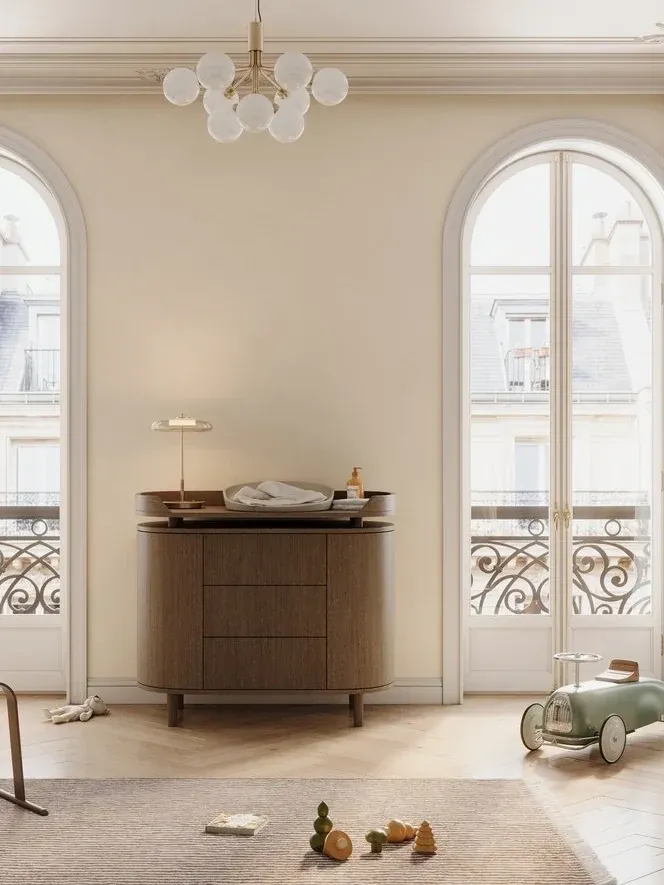
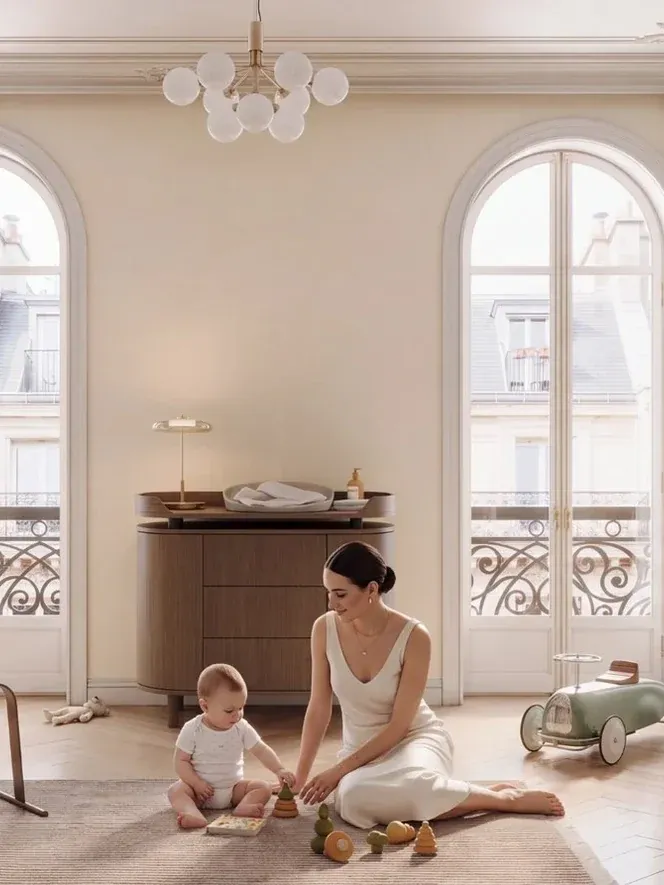
The dresser with its changing top, the toy car and the room itself are the CGI render and stand in exactly the same place in both frames. The mother and child are AI-generated and added on top of the render. That split is the whole method: CGI where accuracy matters, AI where atmosphere matters. See the full Kai Nursery Collection project, or warm timber interiors for a studio in Norway done the same way.
When should a furniture brand choose CGI, AI, or both?
Decide by what the image has to prove. If it has to prove the product, use CGI. If it has to set a mood, AI is enough.
| What you need | Choose |
|---|---|
| Product images for your store, Amazon or Wayfair | CGI |
| The same product in many fabrics and colors | CGI |
| A 360° spin, a GLB file or a configurator | CGI |
| A catalog page or a print brochure | CGI |
| A lifestyle scene with your real products | CGI, with AI people if the room needs life |
| A short ad that has to move | CGI stills + AI animation |
| A mood board for a collection that does not exist yet | AI |
| A social post where no specific product is shown | AI |
When is CGI not the right choice?
CGI is the wrong choice when there is no product to be accurate about. A 3D model is too early and too expensive for a direction you are only testing — next year’s collection, say. Generate moods with AI, decide, and build the model once the design is final.
A one-off image where speed matters more than detail does not need CGI either. One post for tomorrow does not need a model that takes 6–10 hours to build.
One honest note about us: we do not sell AI-generated product photos. If that is what you need, we are not your studio. Our renders are made by 3D artists in 3ds Max and Corona, and we use AI only next to the product, never in place of it.
Frequently asked questions
Is CGI AI?
No. CGI is images made from 3D models that an artist builds and lights. Generative AI predicts new images from prompts and training data. They can work together, but they are different methods.
Does CGI use AI?
In small, technical ways, yes. Corona, the renderer we use, has an AI Upscaler that turns a low-resolution render into a presentation-ready image and an AI Material Generator that builds a material from a photo of a real surface. The model, the camera and the light in the scene are still set by a person.
Is CGI better than AI?
For showing a specific product, yes: CGI matches your dimensions and fabrics and can be repeated from any angle. For quick moods and concepts, AI is faster and cheaper.
Can an AI image show my exact fabric and color?
Not reliably. A generator approximates a reference, and the next image may drift. A CGI fabric is a material matched to your swatch instead, and changing it on a finished model takes 0.5–1 team hour per angle on our plan.
Is CGI more expensive than AI?
The first CGI image costs more, because the model has to be built: 6–10 team hours for a new product with three angles on white. After that, another fabric on the same model takes 0.5–1 hour per angle, and a 360° spin takes 3–6 hours.
Do you use AI in your projects?
Yes, around the product. At Align Interiors in Toronto, we added AI-generated people to about 25 interior renders. For UrbanRest Seating, AI animation turned lifestyle renders into ads with 2.3 times the click-through rate. The furniture itself is always a 3D model.
What is the difference between CGI and AI animation?
Animation has its own trade-offs in cost, speed and control, covered in AI vs traditional 3D animation.
Not sure which one your next collection needs?
Send us your product list and a few reference images. We will tell you what should be CGI, where AI can save time, how long it takes and what it costs — before you commit to anything. If you are still exploring, our short quiz points you to the right format. Or see how we approach furniture rendering and interior visualization.